Table of Contents
ToggleIt’s 2026, and Final Fantasy 1 on NES remains one of gaming’s most influential releases, a game that shouldn’t have worked but somehow became the foundation for one of the greatest franchises ever created. Released in 1987 in Japan and 1990 in North America, the original Final Fantasy wasn’t just a game: it was a lifeline for Square Soft (now Square Enix), a company that literally staked its survival on this single title. Decades later, whether you’re emulating it, playing a remaster on modern hardware, or diving into it for the first time, Final Fantasy 1 holds up in ways that genuinely surprise newcomers. The turn-based combat, the job system, the sprawling dungeons, they all feel purpose-built, not archaic. This guide breaks down what made Final Fantasy 1 NES the game that changed everything, how its mechanics shaped the JRPG genre, and why you should experience it today.
Key Takeaways
- Final Fantasy 1 NES was a lifeline for Square Soft in 1987, proving that story-driven JRPGs could succeed both in Japan and the West, fundamentally saving the company and launching one of gaming’s greatest franchises.
- The job system and turn-based combat in Final Fantasy 1 introduced meaningful party composition choices where resources like HP and MP are genuinely scarce, creating tactical depth that remains relevant to modern JRPG design nearly four decades later.
- The four elemental Fiends structure provides an elegant narrative framework that escalates stakes throughout the 20-30 hour campaign, demonstrating how limited NES cartridge space can still deliver compelling storytelling and strategic boss encounters.
- Final Fantasy 1 NES prioritizes thoughtful mechanics and purposeful design over raw production value, proving that great game design transcends technical limitations and endures across generations of gaming hardware.
- For modern players in 2026, the PlayStation port offers the sweet spot between authentic challenge and quality-of-life improvements, making it the most accessible entry point compared to the brutally obtuse NES original or heavily reimagined remakes.
What Made Final Fantasy 1 A Gaming Revolution
Final Fantasy 1 arrived at a specific moment in gaming history: JRPGs existed, but they weren’t yet a dominant genre. The original Final Fantasy synthesized the best elements from Dragon Quest and earlier RPGs, then added its own identity. The game’s job system, where your four-character party could be built with entirely different class combinations, was genuinely flexible in ways few RPGs at the time allowed.
The combat felt weighty. Every decision mattered because resources like HP, MP, and items were genuinely scarce in the early game. There’s no fast-travel, no constant grinding for levels that trivializes encounters. Instead, players had to manage their party composition, plan spell allocations, and think tactically about when to push forward versus return to town to heal and resupply.
What really separated Final Fantasy 1 from its contemporaries was the narrative framing. You’re not just a party of adventurers, you’re the destined Warriors of Light tasked with restoring the Four Crystals and defeating an increasingly powerful threat. The stakes escalate throughout the 20-30 hour campaign, and by the endgame, you’re genuinely invested in seeing this story to its conclusion. For a 1987 NES game with limited cartridge space, the writing economy is remarkable.
The Origins Of The Franchise
Historical Context And Development
Final Fantasy 1 was developed by a relatively small team at Square Soft under producer Hironobu Sakaguchi. The context matters: Square was near bankruptcy in 1987. Sakaguchi reportedly threatened to leave the company if they didn’t greenlight his dream project, an ambitious fantasy RPG for the Famicom (NES in the West). The company, having little to lose, approved development.
The 1987 release benefited from the NES’s dominance in Japan and the growing appetite for deeper gaming experiences. The Famicom had proven it could host complex titles: the success of Dragon Quest had shown there was an audience for JRPGs. Final Fantasy 1 arrived at exactly the right moment, built on the lessons learned from earlier franchises but with enough originality to stand apart.
The game’s original 1987 Famicom version had some notable quirks and balance issues, especially Magic-heavy builds feeling overpowered in the late game. When ported to other platforms in the 1990s and beyond, many of these problems were addressed, but the NES version remains the purest expression of the original design, warts and all.
A Game That Saved Square Soft
Final Fantasy 1 was a commercial and critical success both in Japan and internationally. It shipped over a million copies, which doesn’t sound massive by modern standards but was significant for a late-life NES title in 1990. More importantly, it proved there was a market for story-driven, mechanically deep RPGs in North America.
The success gave Square Soft the runway to develop Final Fantasy II and III (IV and VI internationally), leading directly to the SNES era dominance that would define the company. Without Final Fantasy 1’s success, there’s no guarantee Square Soft survives long enough to create those classics. The industry’s entire trajectory might have shifted if this game had flopped.
Today, that legacy is undeniable. Players diving into the NES original are experiencing the exact game that started it all, the game that proved Japanese-developed RPGs could succeed in the West and inspired countless developers to pursue the genre.
Gameplay Mechanics That Defined An Era
Turn-Based Combat System
Final Fantasy 1’s combat is deceptively simple on the surface: each turn, you select an action for each party member, then watch as both sides resolve their moves simultaneously. But the simplicity masks tactical depth. Turn order isn’t always clearly communicated in the NES version, meaning some battles require learning enemy patterns and adjusting your strategy accordingly.
The absence of a “miss” command creates interesting resource management. If you’re out of healing items and low on MP, you’re genuinely vulnerable. Some players respec their entire party midway through the campaign because they realized their original composition doesn’t handle later encounters well.
Physical attacks are reliable but low-damage. Magic is powerful but consumes a finite resource (MP), and magic-using classes like Black Mages and White Mages have limited HP, making them fragile. The Fighter and Monk deal consistent physical damage without resource constraints but lack utility. These tradeoffs mean party composition actually matters, you can’t stack four Black Mages and expect to trivialize the game, even though they output absurd damage numbers.
Character Classes And Party Building
Final Fantasy 1 offers six base classes per character slot: Fighter, Thief, Black Belt (Monk), Red Mage, White Mage, and Black Mage. Late in the game, you unlock advanced jobs, Knight, Ninja, Master, Red Wizard, Cleric, and Sage, by equipping specific weapons. This creates a meta-layer of decision-making: which class should you upgrade, and when?
A typical party might include a Fighter (or upgraded Knight) for consistent physical damage, a White Mage (upgraded to Cleric) for healing and utility buffs, a Black Mage (upgraded to Sage) for heavy magical damage, and either a Thief/Ninja for status effects and mobility or a Black Belt/Master for physical damage and durability. But there’s no single “correct” setup, speedrunners have cleared the game with unconventional party compositions.
The magic system is resource-gated by spell slots rather than a mana pool (in the NES version). You select which spells you want to memorize, and you have a set number of slots per spell level. A high-level White Mage might have four slots for Cure, two for Harm, and one for Teleport. This forces meaningful choices about spell coverage versus raw healing capacity.
Magic, Items, And Resources
Magic in Final Fantasy 1 is split between Black Magic (offensive and debuffs) and White Magic (healing and buffs). Both are essential. Black Magic includes Firaga, Blizzaga, Thundaga, and instant-kill spells like Death and Stop, some of which are absurdly powerful against the right enemies. White Magic includes Cure, Full-Life (the most important healing spell), and buffs like Haste and Protectga.
Items are limited and intentional. Potions, Hi-Potions, and Full-Potions serve as backup healing when MP runs dry. Phoenix Down revives KO’d characters, making it a critical resource late-game. Ethers and Elixirs restore MP, with Elixir being exceptionally rare. Smart players hoard these consumables for boss fights rather than burning them on regular encounters.
Weapon and armor drops matter significantly. Finding better gear represents a power spike, making dungeon exploration rewarding beyond just experience and money. By endgame, having maxed-out equipment feels like a genuine achievement rather than a given.
The economy works because enemies drop gold and items at reasonable rates, and towns feel like authentic trading hubs where you resupply. This cycle of: encounter → defeat enemies → return to town → buy items/equipment → tackle next dungeon, creates a satisfying progression loop.
Story, World, And Narrative Design
The Four Elemental Fiends
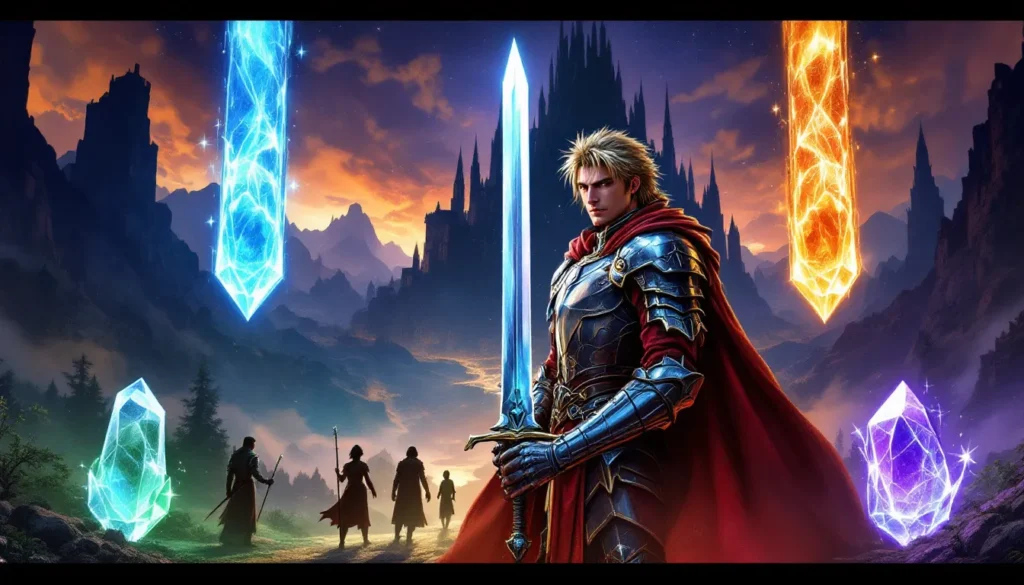
The narrative backbone of Final Fantasy 1 revolves around four corrupted crystals: Fire, Water, Wind, and Earth. Each crystal has been darkened by a Fiend, Marilith (Fiend of Fire), Kraken (Fiend of Water), Tiamat (Fiend of Wind), and Lich (Fiend of Earth). Your Warriors of Light must restore these crystals by defeating each Fiend and cleansing the corruption.
This structure is elegant. Each Fiend occupies a major dungeon, and defeating them unlocks story progression while granting powerful rewards. The final confrontations are genuinely challenging, Marilith can attack four times per turn if she hasn’t been status-affected, Kraken is one of the highest-HP bosses in the game, and Tiamat can devastate unprepared parties with multi-target magic. These aren’t simple damage-check fights: they require strategy.
Beyond the Fiends lies Chaos, the true antagonist and final boss. The game doesn’t hand over this revelation immediately, NPCs hint at a greater darkness, and the endgame dungeon (the Chaos Shrine) feels appropriately apocalyptic. The final confrontation ties the narrative together thematically and is structurally unique compared to other boss fights.
Exploration And Dungeon Design
Final Fantasy 1’s world is expansive by NES standards. You traverse overworld terrain, finding forests, mountains, towns, and castles. Dungeons vary wildly in structure, from straightforward linear progression to genuinely maze-like layouts that reward thorough exploration.
The original NES version’s dungeons include some infamous layouts, the Marsh Cave and Dungeon 5 are genuinely labyrinthine, and many players remember getting lost. Later remakes added more intuitive navigation and objective markers, but purists argue the original’s obtuseness created a sense of danger and discovery. If you’re stuck, you’re expected to puzzle it out or consult a physical guide (or today, the internet).
Chests contain valuable loot, some hidden in dead-end rooms. The game respects your thoroughness, wandering into a suspicious dark corner might yield an Elixir or powerful weapon. Boss encounters often require specific approaches: some are vulnerable to magic, others to physical attacks, and a few have gimmick mechanics that become obvious only after a failed attempt or two.
NPCs deliver exposition efficiently. They rarely waste your time with lengthy dialogue: instead, you get information about where to go and why it matters. This pacing creates momentum that carries through the roughly 20-30 hour campaign without feeling bloated.
Comparing Final Fantasy 1 NES To Modern Versions
Original NES Vs. Remakes And Ports
The 1987 NES version (and its later cartridge ports) is the purest, most challenging rendition. It has balance issues, the interface is clunky by modern standards, and the spell-slot system creates inventory management headaches. But it’s also the most rewarding for players who embrace those quirks.
The PlayStation port (1987 onwards, rereleased in the mid-1990s) introduced quality-of-life improvements: a mana pool instead of spell slots, rebalanced encounters, and improved translation. The interface feels less obtuse. Many consider it the best “authentic but accessible” version for modern players who want the original experience without wrestling the NES version’s quirks.
The Game Boy Advance port added additional endgame content and further refinements. The smartphone/tablet versions modernized the interface further but sometimes feel overdesigned, the pixel art upscaling looks muddy, and the touchscreen controls don’t always feel responsive.
The 2013 3D remake (“Dissidia Final Fantasy: 20th Anniversary Edition” era) fundamentally reimagines the game. Job progressions, stat progression, and combat pacing are altered significantly. It’s fun, but it’s not Final Fantasy 1 in any meaningful way, it’s a spiritual successor using the 1 skin.
For new players in 2026, the PlayStation port remains the sweet spot: it preserves the original’s challenge and structure while removing the most frustrating friction points. Speedrunners and purists prefer the NES version, understanding its quirks and optimizing around them.
Quality Of Life Improvements Across Versions
The NES version forces you to navigate menus to see character stats, which is cumbersome. Later versions display this information more intuitively. Spell organization improves across iterations, the NES version’s slot-based system is replaced with a simpler mana pool in later ports, making resource management feel less like inventory Tetris.
Navigation improves dramatically. The NES version’s dungeons are intentionally maze-like: finding the exit requires trial-and-error or consulting a guide. Remakes add subtle directional hints and objective markers that respect player intelligence without holding hands.
Combat pacing accelerates in later versions. The original NES version’s animations are slow: battles against weak enemies drag. Modern ports feature faster attack animations and auto-battle options for trivial encounters.
Translation quality jumps between versions. The NES localization is charmingly awkward (the famous “THERE ARE FOUR LIGHT WARRIORS” greeting). Later translations are more comprehensible but lose some personality. The original Japanese-to-English transition was imperfect, but it gave the game character.
Saving is more forgiving in modern versions. The NES version uses a single save file: if you save before a dangerous dungeon, you’re committed. Later versions allow multiple saves and quick-save functionality, reducing frustration without eliminating challenge.
How To Play Final Fantasy 1 Today
Emulation And Legal Access
If you own an original NES cartridge or SNES rom cartridge, playing the original via emulation is straightforward. Emulators like Nestopia or FCEUX (for NES) run the 1987 game perfectly, and they’re free. But, legally acquiring a rom requires owning the game or ensuring the rom is from an authorized preservation source, buying cartridges on the secondhand market is expensive (original NES copies run $20-40), but it’s the legal route if you want the authentic NES experience.
The PlayStation version is widely available on emulators and even in recompiled form for modern systems. It’s also available on PlayStation Network’s retro catalog, making it a legal, affordable option for most players.
The mobile versions (iOS and Android) are the most accessible legally, costing roughly $10-15. They’re the easiest way to experience Final Fantasy 1 on modern hardware without worrying about emulation legality.
The GBA version is harder to find now but is occasionally re-released on Nintendo Switch Online (though availability varies by region). If you subscribe to Switch Online, check your library, it might already be there. Resources like RPG Site regularly cover which classic Final Fantasy titles are available on modern platforms, and Siliconera tracks re-releases and news about the franchise.
Essential Tips For New Players
First, understand that this game respects your time but also expects you to engage with it. Don’t rush dungeons: read NPC dialogue for hints about where to go next and what challenges await. Many players miss crucial story details because they’re powering through.
Specialize your party early. Decide whether you want a magic-heavy composition or physical-focused, because respec-ing is time-consuming (you have to find new classes and grind levels). Generally, a balanced team works: one heavy physical damage dealer (Fighter or Black Belt), one healer (White Mage), one damage-caster (Black Mage), and one utility/secondary damage (Red Mage or Thief). This setup trivializes no encounters but handles most situations competently.
Manage resources obsessively. Buy healing items when you have gold: don’t assume you’ll find them. Hoard Phoenix Downs for boss fights. Upgrade weapons and armor as soon as you can afford them, the stat improvements matter more in the NES version than in later ports.
Level up more than you think you should. The NES version is harder than later remakes, especially in the Chaos Shrine dungeon (the final gauntlet). If you’re struggling, grind 3-5 more levels. It sounds tedious, but encounters in NES Final Fantasy are generally quick, and leveling feels rewarding.
Boss patterns matter. Write down what bosses do, which attacks they prioritize, which party members they target, whether they have status effects. Some bosses can be one-shot by using Stop magic or instant-death spells if you figure out the gimmick. Don’t just brute-force through every encounter.
The original Final Fantasy 1 in 1987 was designed to be completed, not broken. You’re expected to struggle with some bosses, but failure is avoidable with proper preparation and strategy. If you’re dying repeatedly to the same encounter, it’s usually a sign to adjust your strategy or grind levels, not a sign the game is unfair. If you’re enjoying Final Fantasy 14’s modern experience, the original’s slower pacing and harsher difficulty might feel shocking, adjust your mindset accordingly.
Why Final Fantasy 1 Still Matters To Gamers
Playing Final Fantasy 1 in 2026 isn’t nostalgia tourism: it’s understanding gaming archaeology. This game proves that the fundamentals of good JRPG design, meaningful party composition choices, resource scarcity that creates tension, bosses that require strategy, and narrative stakes that grow as you progress, haven’t fundamentally changed in nearly four decades.
Modern JRPGs add complexity: equipment systems with dozens of stats, elemental wheel interactions, active-time battle mechanics, and cosmetic gacha. But at their core, they’re still Final Fantasy 1 with more layers. Understanding the original teaches you why those systems exist and why certain design choices feel satisfying versus frustrating.
The game’s economy of storytelling is relevant to modern development. Every NPC has a purpose. Every dungeon advances the narrative. There’s no filler quest that wastes your time, every objective is meaningful. In an era where open-world games can feel bloated with meaningless collectibles, Final Fantasy 1’s focus feels refreshing.
Speedrunners still actively play the 1987 NES version, optimizing routes and glitch exploits. The Metacritic reviews and aggregated scores for classic Final Fantasy games show that critical reception has aged remarkably well, the game scores higher in modern retrospectives than it did at launch.
Most importantly, Final Fantasy 1 proves that great game design transcends technical limitations. It’s limited by 1987 hardware constraints, yet it creates an experience that engages players emotionally and intellectually. That’s the mark of craftsmanship that endures. Twenty-first-century hardware lets developers add voice acting, photorealistic graphics, and orchestral soundtracks, but none of those things automatically make a game better. Final Fantasy 1 proves that thoughtful mechanics and purposeful design matter more than raw production value. If you care about understanding where modern gaming came from and why certain mechanics feel good, this game is essential.
Conclusion
Final Fantasy 1 NES remains a landmark achievement in gaming history, the game that proved Japanese developers could create experiences that resonated globally and that JRPGs were here to stay. The 1987 original and its various remakes and ports offer different flavors of the same fundamentally sound experience: a game where your party composition matters, resource management creates tension, and combat encounters reward strategic thinking over reflexes.
Whether you approach the brutal 1987 NES version, the more accessible PlayStation port, or a modern mobile version, you’re playing a game that influenced virtually every JRPG that followed. The job system, the elemental narrative, the dungeon design, these choices have echoed through 40 years of the genre.
In 2026, gaming has exponentially more options than 1987 did. Yet revisiting where it all began offers perspective. Final Fantasy 1 reminds you that great game design is timeless: meaningful progression, fair difficulty, and stakes that matter. That’s the legacy that matters most.