Table of Contents
ToggleBefore Final Fantasy VII redefined the genre, before Cloud and his oversized buster sword became icons, Square was experimenting with something different. Final Fantasy Mystic Quest, released in 1992 in North America and 1993 in Japan (titled Final Fantasy USA), was Square’s earnest attempt to bring JRPGs to Western audiences who had little exposure to the genre. It’s a game that’s been dismissed, mocked, and largely forgotten, but that misses the point entirely. Mystic Quest wasn’t trying to be a mainline Final Fantasy. It was a streamlined, accessible gateway drug designed to teach RPG mechanics to players who’d never grind for experience or navigate a menu system before. Understanding what Mystic Quest tried to do, and how it actually succeeded in its own context, reveals something important about game design philosophy and audience targeting that still resonates in 2026.
Key Takeaways
- Final Fantasy Mystic Quest was intentionally designed as an accessible gateway to JRPGs for Western audiences who had never experienced the genre, not as a simplified mainline Final Fantasy title.
- The game’s streamlined mechanics—including no random encounters, deterministic combat, straightforward magic, and linear dungeons—succeeded at teaching RPG fundamentals without alienating newcomers.
- Modern reassessment reveals that Mystic Quest’s accessibility-focused design philosophy influenced how contemporary RPGs approach onboarding and difficulty settings, from Dark Souls to Final Fantasy XIV.
- Despite initial mixed reception and later dismissal, Final Fantasy Mystic Quest has earned renewed appreciation from speedrunners, emulation communities, and modern gamers who recognize its solid, charming execution and historical importance to JRPG localization.
- The game proves that intentional simplification isn’t design failure—when executed thoughtfully, a 30-hour well-paced adventure can be more valuable than a 100-hour game padded with unnecessary complexity.
What Is Final Fantasy Mystic Quest?
Final Fantasy Mystic Quest is a 1992 SNES action-RPG developed by Square. It’s the only mainline Final Fantasy game developed exclusively for Western markets, though it later received a Japanese release under a different title. The game puts players in control of a young protagonist who discovers he’s the “Mystic Knight”, destined to save the world from supernatural darkness threatening the land.
Unlike most JRPGs of its era, Mystic Quest stripped away complexity in favor of accessibility. The game has no random encounters: enemies appear visibly on the overworld and dungeons. Combat is turn-based but faster-paced than contemporary RPGs. Dungeons are shorter and more forgiving. Magic is straightforward, with clear damage values and effects. There’s even an “easy” mode for absolute beginners.
The game ran on the SNES engine and featured colorful, Mode 7-style visuals with a distinctive art direction. Its 30-40 hour campaign was manageable for console RPG standards at the time. Players could expect a complete, self-contained story without the sprawling 50+ hour commitments that defined mainline Final Fantasy titles.
Mystic Quest exists in this weird space: too simple for hardcore FF fans, too complex for casual players seeking mobile-game-level simplicity, yet perfect for someone dipping their toes into JRPGs for the first time. That positioning defined both its initial reception and its place in gaming history.
The Development Story and Why It Exists
Square’s Strategy for Western Audiences
In the early 1990s, Square looked at the Western gaming market and saw a problem: JRPGs barely existed outside Japan. The Dragon Quest series had no Western presence. Final Fantasy IV (then called “Final Fantasy II” in the West) sold respectably on SNES, but the audience remained niche. Square’s leadership recognized an opportunity, but also a challenge. Western gamers, particularly Americans, weren’t trained to understand JRPG conventions. Random encounters, grinding, complex menu systems, and abstract narratives felt alienating.
Square’s solution? Create a Final Fantasy that taught JRPG fundamentals from the ground up. No unnecessary complexity. No obtuse progression systems. No story beats that required familiarity with Final Fantasy lore. Just a straightforward adventure that proved the genre could work for non-Japanese audiences.
This wasn’t dumbing down for the sake of it. It was intentional design aimed at education. Square producer Hiromichi Tanaka and designer Akari Shinohara developed Mystic Quest as a stepping stone, a game that would prepare Western players to appreciate more complex titles.
Creative Vision and Design Philosophy
The design philosophy behind Mystic Quest prioritized clarity and pacing over depth. Dungeons were designed with straight paths rather than branching mazes. Puzzles relied on observation rather than obscure pixel hunting. Magic spells showed exact damage numbers and durations. The difficulty curve remained gentle, allowing players to progress without excessive grinding.
Square intentionally avoided the aesthetic that would define their later work. No androgynous pretty-boys. No existential crises. No time-traveling plot twists. Instead, Mystic Quest embraced a more traditional fantasy aesthetic with a younger protagonist, clear-cut good-versus-evil narrative, and straightforward character archetypes.
The team knew 3DS RPG Games had proven that handheld systems could support the genre, but console players in the West hadn’t experienced that level of accessibility before. Mystic Quest aimed to be the console equivalent, a training wheels RPG that didn’t talk down to players but acknowledged their starting point.
Gameplay Mechanics and Features
Combat System and Battle Mechanics
Combat in Mystic Quest happens exclusively in separate battle screens. When players encounter an enemy, they’re transported to a arena-like environment distinct from the overworld. This design choice eliminated the random encounter tedium while keeping battles contained and manageable.
The system itself is pure turn-based simplicity:
- Attack: Direct physical damage based on equipment.
- Magic: Spells cost MP and vary in power and effect.
- Item: Use potions, status remedies, or consumables.
- Guard: Reduce incoming damage for that turn.
Damage is deterministic. There’s no critical hit RNG. No attack misses. Players know exactly how much damage they’ll deal and take. This predictability made Mystic Quest approachable for players unfamiliar with battle mechanics.
Enemy variety remains limited by modern standards. Most encounters feature 1-3 enemies with clear patterns. Boss fights telegraph their attacks and weaknesses. A player who experiments with different spells quickly discovers which are effective. The game doesn’t punish experimentation, it encourages it.
TTK (time-to-kill) is brisk. Most encounters resolve in 2-3 rounds. Longer battles become a slog, so the pacing keeps combat engaging without wearing players down.
Puzzle Solving and Dungeon Exploration
Dungeons in Mystic Quest are intentionally straightforward. Linear paths with occasional branching lead to clear objectives. Puzzles involve moving boulders, hitting switches in specific orders, or obtaining keys. Nothing requires external guides or illogical leaps of faith.
Environmental design supports player navigation. Walls have clear textures. Important objects stand out. NPCs provide hints when players linger in an area. The game trusts players to understand spatial relationships without hand-holding, but also respects their time by not requiring pixel-perfect searches.
Some dungeons introduce simple environmental hazards: lava floors, ice tiles that reduce friction, darkness that obscures vision. These mechanics get introduced gradually, ensuring players understand each concept before complexity increases. By modern standards, this structure feels almost tutorialized, but it’s effective for teaching.
Treasure is distributed generously but fairly. Players who explore thoroughly find additional equipment and healing items. This rewards curiosity without making optional content mandatory for progression.
Character Progression and Magic System
Mystic Quest features four playable characters: the protagonist (Benjamin), Kaeli, Phoebe, and Reuben. Each learns unique magic and has distinct equipment paths. Even though having four party members, players control only the protagonist in battles. Other characters act on auto-pilot using AI-determined actions. This streamlined combat further, making battles simpler to manage while reducing decision paralysis.
Magic progression is tied to story advancement and leveling. Characters don’t gain experience directly: instead, leveling happens automatically through plot progression and optional monster encounters. Growth feels organic rather than gated behind grinding.
Spells include offensive magic (fire, ice, lightning), healing, status effects, and utility. Each spell shows its MP cost, damage value, and effect. Learning new spells doesn’t clutter menus, old spells remain alongside new ones, creating a full arsenal rather than forcing choices.
Equipment progression follows traditional JRPG logic: better swords, armor, and helmets drop from enemies or appear in treasure chests. Stat growth from equipment is gradual. No single piece offers game-breaking power.
The leveling cap is level 99, but reaching it requires significant post-game grinding. The main story concludes around level 40-50, providing perspective on intended progression pacing.
Story, Characters, and Worldbuilding
The Narrative and Main Quest
Mystic Quest’s story is deliberately straightforward. A dark force called the “Dark King” has corrupted the world, draining it of light and energy. Benjamin, a young man living in a peaceful village, discovers he’s been chosen as the Mystic Knight, a legendary hero destined to save the world. He embarks on a journey to restore four elemental crystals and stop the Dark King’s resurrection.
The narrative follows a clear three-act structure. Act One explores the basic plot: Benjamin learns of his destiny and must find Kaeli, a companion. Act Two involves gathering the party and seeking the crystals across different lands. Act Three confronts the Dark King in his fortress and concludes the story.
Plot twists exist but never contradict established lore. Characters have motivations that make sense within the world. The pacing ensures players reach story beats at natural intervals, preventing exposition dumps or extended dialogue sequences that might lose Western audiences.
The writing style adapts to an English-speaking audience. Final Fantasy games translated before Mystic Quest often felt awkward or overly literal. Mystic Quest’s localization prioritizes clarity and natural speech patterns, making dialogue feel genuine rather than translated.
Memorable Characters and Party Dynamics
Even though limited party interaction, Mystic Quest’s characters have personality. Benjamin is earnest and determined but not obnoxiously heroic. Kaeli brings optimism and wonder. Phoebe offers wisdom and magical expertise. Reuben provides humor and sass, often questioning Benjamin’s decisions.
Character arcs resolve satisfyingly. Each party member joins with clear motivations and experiences growth by story’s end. Their departures (or unexpected returns) create emotional weight even though limited screen time.
NPC relationships matter. Village elders provide context. Merchants serve practical purposes. Enemies have names and backstories, not just generic “Skeleton” or “Goblin” entries. This personalization, but subtle, made the world feel lived-in.
The supporting cast includes memorable figures: the mysterious magician, the castle prince, the elder responsible for guiding Benjamin. They reappear at key story moments, creating continuity. By SNES standards, this was solid character development even though the game’s accessibility focus. The narrative shows that you don’t need convoluted plot mechanics to tell an engaging story, clear character motivations and consistent pacing accomplish far more.
Technical and Artistic Presentation
Graphics, Music, and Sound Design
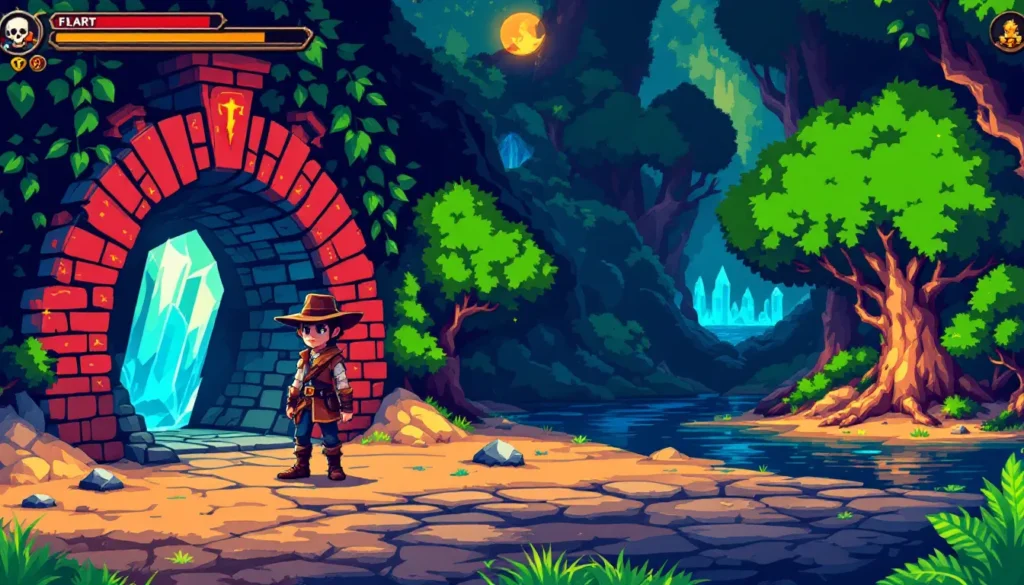
Mystic Quest’s visuals prioritize clarity and color over technical showcase. The SNES’s Mode 7 effects appear in the overworld, creating a subtle rotating effect when moving between areas. It’s not flashy, but it adds visual interest without overwhelming the presentation.
Character sprites are well-animated even though sprite memory limitations. Walking animations feel fluid. Battle animations have weight and impact. Monster designs range from traditional dragons and imps to more exotic creatures, keeping visual variety engaging across a 30+ hour campaign.
Environmental design uses color effectively. Forests are lush and green. Deserts are warm oranges and yellows. Water areas use blues and teals. This color coding helps players intuitively understand their location without requiring map screens or constant orientation checks.
Music was composed by Kei Shigema and Ryoji Yoshitomi. Tracks vary from upbeat exploration themes to dramatic boss music to melancholic town themes. The soundtrack supports the narrative without overshadowing it. Boss fights have unique themes that intensify encounters. Village music encourages lingering and exploration.
Sound effects are serviceable. Attack sounds vary by weapon type and magic effect. Damage feedback is clear, players immediately know when attacks connect or miss (though, as noted, there are no misses in the traditional sense). Environmental audio includes subtle ambient effects: wind, water, creature sounds.
By modern standards, the presentation is decidedly dated. Pixels have aged better than 3D models from the same era, and RPG Site coverage of retro games often notes that turn-based combat ages far more gracefully than action-based systems from the 90s. Mystic Quest holds up surprisingly well because its straightforward art direction and functional UI remain legible across re-releases and emulation.
Cultural Impact and Legacy
Critical Reception and Fan Reception Over Time
Initial reviews were mixed to positive. Gaming magazines praised Mystic Quest’s accessibility and noted it succeeded at introducing JRPGs to Western audiences. Critics acknowledged the game was simpler than Final Fantasy IV but didn’t necessarily criticize that choice, many understood Square’s intention.
Over time, perception shifted. As the 1990s progressed and JRPGs exploded in popularity, Mystic Quest became a footnote. Hardcore fans dismissed it as “not a real Final Fantasy.” The game wasn’t included in early anniversary collections. It rarely appeared in “best of” lists. When it was mentioned, the tone ranged from apologetic to dismissive.
But, recent years have seen reassessment. Retrospective articles and video essays have contextualized Mystic Quest within Square’s broader strategy. Speedrunners have discovered the game’s appeal. Emulation has made it accessible to new audiences unbound by original cartridge costs. Modern gamers approaching Mystic Quest fresh, without baggage from SNES-era debates, often find it charming and well-designed.
Fan communities on Reddit and Discord discuss Mystic Quest with genuine affection. Speedrun records are tracked and competed over. ROM hacks and fan translations expand the game’s life. This grassroots appreciation suggests the game’s reputation is healing as nostalgia cycles and revisionist analysis gain traction.
Influence on Modern Final Fantasy Titles
Mystic Quest’s direct influence on subsequent Final Fantasy games is subtle but present. The series never again attempted accessibility to Mystic Quest’s degree, but elements persisted. Streamlined UIs in later games reflect lessons learned from making menus approachable. Balanced difficulty curves echo Mystic Quest’s pacing principles.
Modern Final Fantasy remakes, particularly Final Fantasy VII Remake and the ongoing Final Fantasy XVI development, incorporate accessibility features: difficulty settings, toggleable tutorials, customizable UI. This philosophy, making games welcoming without compromising design, is present in Mystic Quest decades earlier.
Japanese coverage on sites like Gematsu occasionally references Mystic Quest in retrospectives about Square’s Western expansion strategy. It’s recognized as an important chapter in JRPG localization history, even by international gaming media that initially overlooked it.
The game proved an important lesson: simplicity isn’t failure. A streamlined design can be artistically valid and commercially viable if executed with intention. That lesson influenced how RPGs approach onboarding and accessibility design in subsequent generations. Modern games from Dark Souls to Final Fantasy XIV have learned from Mystic Quest’s success, not by copying it, but by understanding that complexity and accessibility aren’t mutually exclusive when thoughtfully balanced.
How Mystic Quest Compares to Other FF Titles
Differences from Mainline Final Fantasy Games
Mystic Quest stands apart from other FF entries in fundamental ways. While most Final Fantasy games build worlds of staggering complexity, Mystic Quest embraces simplicity. Final Fantasy IV (1991) featured a branching narrative with multiple protagonists and deep character development. Mystic Quest has one clear protagonist and a linear story.
Combat differs significantly. Traditional FF games use ATB (Active Time Battle) systems where turn order is based on character speed stats. Mystic Quest uses pure turn-based combat where turn order is predetermined. No speed stats. No haste/slow mechanics affecting turn frequency. This removes layers of strategic depth but increases accessibility.
Magic systems in classic FF games are robust and complex. Final Fantasy IV has spell tiers, limited MP pools that require management, and distinct magic categories. Mystic Quest presents magic as straightforward learned spells with clear effects. It’s reductive, but intentionally.
Party mechanics differ too. Final Fantasy IV requires active player input for all party members during combat. Mystic Quest automates three party members’ actions. Some players view this as a limitation: others recognize it reduces cognitive load while maintaining strategic choice.
Difficulty scaling is more forgiving in Mystic Quest. Final Fantasy IV can punish players for suboptimal choices and requires specific strategies for certain boss fights. Mystic Quest bosses have patterns but remain beatable through standard tactics. The learning curve is gentler.
Story and tone differ substantially. FF games embrace melodrama, philosophical complexity, and (often) tragic narratives. Mystic Quest’s story is earnest but straightforward. The tone remains consistently adventure-focused rather than shifting between romance, existentialism, and despair.
Even though these differences, Mystic Quest is mechanically sound. It doesn’t fail as a design, it succeeds at a different objective than mainline FF titles. Comparing them is like comparing a motorcycle to a sedan: different vehicles for different purposes.
Modern Remakes and Re-releases
Mystic Quest hasn’t received an official remake, which is notable given how many other SNES-era RPGs have. There’s no Mystic Quest Remake comparable to Final Fantasy VII Remake or the upcoming Final Fantasy IX reimagining rumored in development.
The game has appeared in re-releases through emulation and ROM distribution. The original cartridge remains available on the second-hand market, though prices have risen as retro game collecting has become more mainstream. Nintendo Switch Online, the emulation service providing classic SNES games, includes Final Fantasy titles but notably omits Mystic Quest, suggesting licensing or rights complications.
Fans have created ROM hacks and fan translations, including sprite replacements and gameplay rebalances. Some hacks make Mystic Quest deliberately harder, targeting speedrunners and challenge-seeking players. Others add cosmetic changes or alternate storylines. These community efforts keep the game alive in enthusiast circles.
The lack of official modern treatment contrasts with Final Fantasy 14 and other mainline entries that receive constant support and re-releases. This reflects Mystic Quest’s unusual place in the franchise, important historically but not commercially valuable enough to justify remake investment. That may change as retro gaming nostalgia continues cycling, but as of 2026, Mystic Quest remains frozen in time rather than modernized.
Playing Mystic Quest in 2026
Where to Play and Emulation Options
Finding Mystic Quest legally in 2026 involves several options. Original SNES cartridges are available through second-hand markets, though prices typically range from $30-$100 depending on condition and whether the box/manual is included. The investment is worthwhile for collectors but overkill for casual play.
Emulation through official channels is limited. Nintendo Switch Online doesn’t include Mystic Quest in its SNES library, which is unfortunate given its accessibility focus would appeal to modern console players. This absence stems from licensing or rights holding by Square Enix.
PC emulation is straightforward. Emulators like SNES9x or Higan run Mystic Quest perfectly. ROMs are available through legitimate sources like abandonware sites (legal gray area) or obtained through cartridge dumping if players own originals. This remains the most accessible path for most gamers.
Mobile emulation through RetroArch or similar apps lets players experience Mystic Quest on smartphones and tablets. The smaller screens don’t impact gameplay significantly since Mystic Quest’s UI is legible even scaled down. This flexibility makes retro gaming accessible to players accustomed to mobile platforms.
Some emulator packages come with user-friendly setup guides, making the technical barrier virtually nonexistent for modern gamers. Unlike some retro games requiring tweaking or ROM hacking to function properly, Mystic Quest works out-of-the-box across emulation platforms.
Tips for Modern Gamers
Approaching Mystic Quest with proper expectations makes the experience far more enjoyable. Modern gamers expecting the complexity of Final Fantasy VII or XV will be disappointed. But players who recognize Mystic Quest as an accessible entry point find genuine charm.
First tip: Don’t grind excessively. The game’s difficulty curve is designed for steady progression with minimal optional encounters. Players grinding dozens of battles will overpower themselves and trivialize encounters. Fighting standard enemies on the overworld while traversing dungeons provides sufficient experience.
Second: Explore thoroughly but don’t obsess. Dungeons hide treasure chests with useful equipment. Finding them enhances power without being mandatory. This balance lets casual players progress through the main story while rewarding thoroughness.
Third: Experiment with magic early. New players should test different spells in early battles to understand their effects. The game doesn’t punish experimentation, and understanding your toolkit before later boss fights matters.
Fourth: Accept the simplified mechanics as intentional design rather than limitation. Single-character control, auto-attacking AI party members, and deterministic combat aren’t poorly designed, they’re conscious choices supporting accessibility. Embracing them rather than resisting them improves enjoyment.
Fifth: Use saving liberally. The game allows saving anywhere except during battles. Saving before boss fights or challenging dungeons removes frustration without cheapening accomplishment. There’s no achievement in suffering through avoidable setbacks.
Final tip: Read dialogue and explore NPC interactions. While Mystic Quest’s story is straightforward, NPCs provide context and character moments that enrich the experience. The localization is solid, and voice acting (absent) doesn’t distract. Taking time to engage with the narrative elevates Mystic Quest from serviceable adventure to worthwhile storytelling experience. Final Fantasy 14 Quest design philosophies show how modern FF games have built on accessibility principles Mystic Quest pioneered, players comfortable with contemporary FF questlines will find Mystic Quest’s structure familiar and welcoming.
Conclusion
Final Fantasy Mystic Quest exists in that fascinating space between maligned relic and underrated gem. It wasn’t trying to be Final Fantasy IV’s equal or Final Fantasy VII’s predecessor. It was explicitly designed as an onramp, a game that recognized Western audiences needed introduction to JRPG conventions and provided that education without condescension.
That mission succeeded. Mystic Quest proved JRPGs could appeal to broader audiences through thoughtful design. Simplification isn’t failure when executed with clear intention. A 30-hour adventure beats a 100-hour slog if those hours are well-spent. These lessons shaped how RPGs approach accessibility today, from Dark Souls’ difficulty settings to Final Fantasy XIV’s streamlined early game to indie RPGs that prioritize player respect over padding.
Modern players discovering Mystic Quest often report surprise. They expected a broken relic and found instead a solid, charming adventure. The pixel art holds up. The music resonates. The story, while straightforward, engages. The mechanics, while simple, function beautifully.
In 2026, with decades of hindsight, Mystic Quest deserves reassessment. It’s not a masterpiece, but it’s not the franchise embarrassment its reputation suggests. It’s a skilled stepping stone that taught Western audiences to appreciate JRPGs, and in doing so, influenced everything that followed. That’s a legacy worth acknowledging. Whether you’re a completionist hunting every Final Fantasy title or a modern gamer curious about JRPG history, Mystic Quest rewards patient engagement. Give it a chance. It’s earned one.